

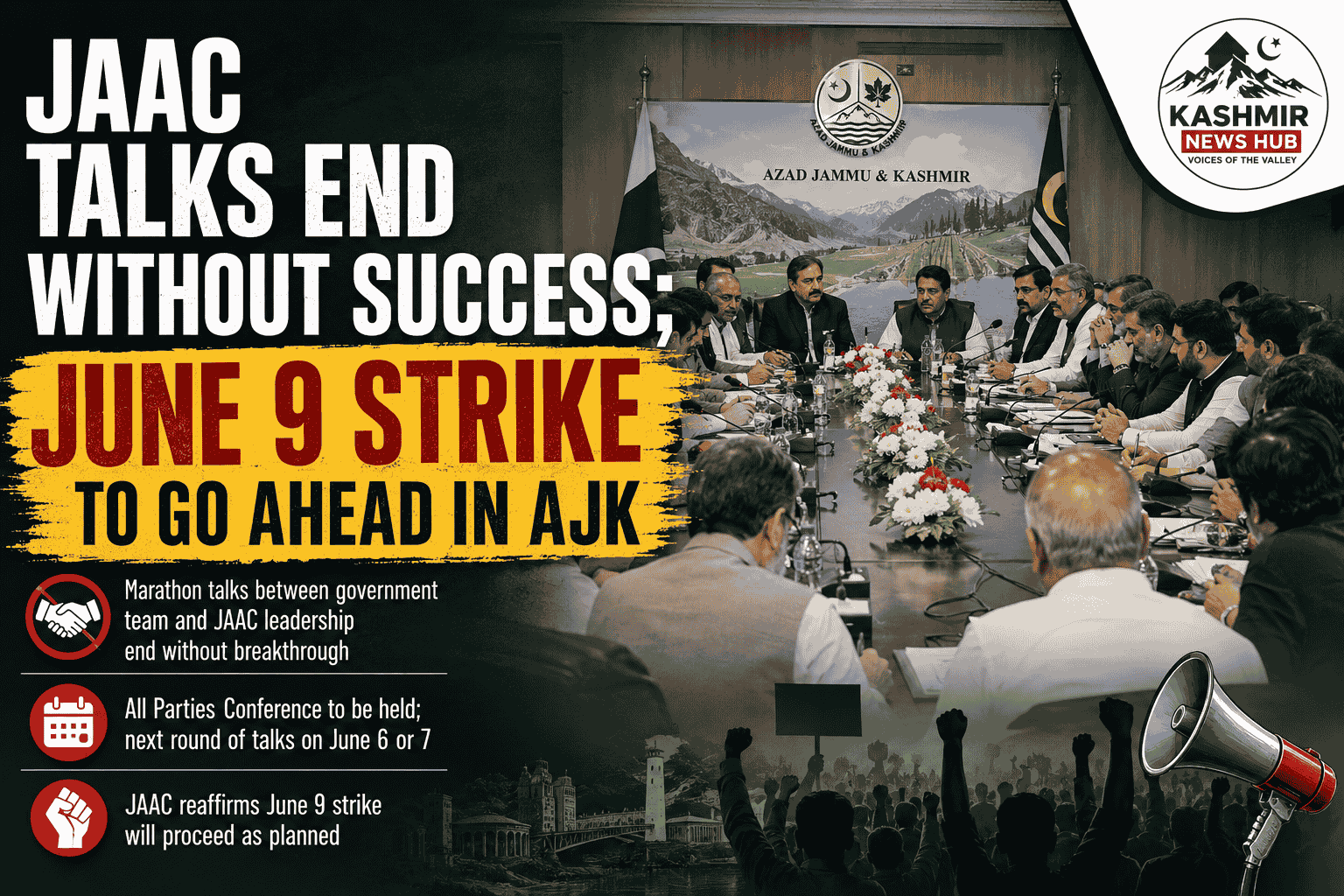
The ministerial team of the federal Government has completed an important round of talks with the leadership of Jammu Kashmir Joint Awami Action Committee (JAAC) late Saturday night without any breakthrough, and JAAC has confirmed that the strike scheduled to be observed on June 9 would continue in Azad Jammu and Kashmir (AJK).
The marathon discussion, which sought to solve the disagreement on the charter of demands of the JAAC and persuade them to withdraw their call for a strike, lasted over 9 hours with breaks. The impasse has heightened fears over political stability in AJK ahead of its expected general elections later this summer.
JAAC calls for strikes to continue
JAAC core member Shaukat Nawaz Mir told journalists after the meeting that a lot of discussion had been held between the committee representatives and the officials of the Pakistan and AJK government around 11.20 PM.
Mir said all the major issues from the highly contentious 12 seats allocated to refugees in the AJK Legislative Assembly were discussed in detail. It discussed proposals and invited government officials to delay the strike, but the committee finally decided to stick to its original stand.
He added, however, that the JAAC is ready to continue discussions and negotiations.
Also, visit Obituary: Barrister Sultan Mehmood Chaudhry (1955–2026) – Final Journey
The Politics of Election and Political Stability under Pressure
The talks were initially meant to take place in the backdrop of preparations for the general elections in Azad Kashmir, which has been a delicate period with the negotiations failing. The officially announced election dates are yet to be released, but political analysts believe it will be the last week of July.
Election preparations could be hampered by the possibility of continued protests and political turmoil, which could have an impact on the electoral process.
Senior-level Federal and Regional Representation
The federal delegation consisted of some renowned political leaders such as Rana Sanaullah, Tariq Fazal Chaudhry and Ahsan Iqbal of Pakistan Muslim League-Nawaz (PML-N). Former Prime Minister Raja Pervaiz Ashraf and former federal minister Qamar Zaman Kaira spoke on behalf of the Pakistan Peoples Party (PPP).
Faisal Mumtaz Rathore, the AJK Prime Minister, PPP regional president Chaudhry Muhammad Yasin, PML-N regional president Shah Ghulam Qadir and party regional secretary-general Chaudhry Tariq Farooq also attended the meeting.
Minister for Kashmir Affairs Amir Muqam was also not included in the list. He was eventually removed after a number of requests by the JAAC leadership for his exclusion from negotiation owing to allegations of bias. The federal delegation members said that Muqam was busy with the Gilgit-Baltistan elections.
The delegation of JAAC had 16 key members, namely Shaukat Nawaz Mir, Raja Amjad Ali Khan, Anjum Zaman Awan, Umar Nazir Kashmiri, Saad Ansari and Imtiaz Aslam.
Refugee Seats are still the primary flashpoint of conflict
According to sources close to the negotiations, 37 of the demands presented by the JAAC were discussed in the first session of the negotiations. One problem that still has not been resolved and is still the main hurdle in coming to an agreement is the future of the 12 seats in the legislative assembly that are reserved for the refugees of Indian-administered Kashmir who migrated to Pakistan.
The one most contentious issue in the negotiations is the refugee seats. The PML-N’s AJK chapter is vehemently opposed to their removal as the party is anticipating to get good support from the refugee constituencies in Punjab. The PPP, which is supported by several in the refugee community in Parliament, is seen as being less determined to safeguard the current system.
Discussion, perseverance, and a move forward
The first round of talks started about 2 PM and lasted until 4 PM. Discussions resumed after a break at 6:10 PM and were interrupted only late into the night.
After the meeting, Rana Sanaullah has denied the notion that the talks had come to an end altogether. The dialogue is ongoing and both sides have had constructive discussions, he added.
Sanaullah said that AJK government and the opposition PML-N have agreed on an All Parties Conference (APC) for discussing the overall political scenario and the demands put forward by the JAAC.
The conference is followed by another round of negotiations on June 6 or 7.
What Happens Next?
The June 9 strike is still on the table with some points of disagreement yet to be addressed, with focus shifting now to All Parties Conference and the next step in talks. Political leaders still hope the issues can be settled prior to the forthcoming elections.
But for now, the JAAC has renewed its demand to continue with the strike, thus setting the tone for a crucial week in the political arena of Azad Jammu and Kashmir.
Check this out UK Work Permit Guide 2026: How to Find Registered Companies and Get Sponsored